The Ant and the Grasshopper
A story of prudence · About 4 minutes
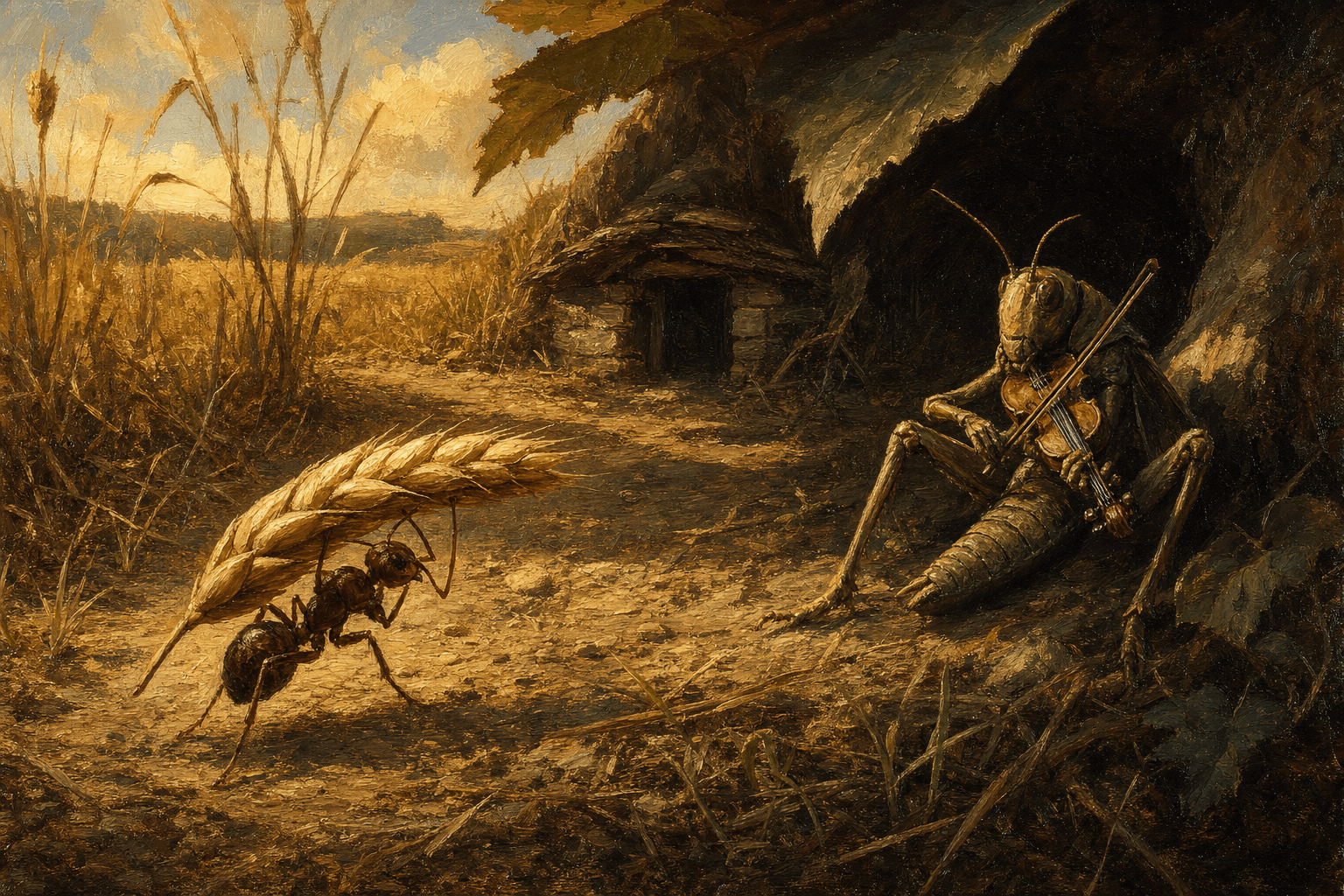
The afternoon was warm, and the field was loud with summer. Grasshopper sat in the dust beneath a thistle leaf, tuning his fiddle. He had been playing since morning. The bees hummed near him, and two sparrows tipped their heads from the fence, listening as if the whole day had been made for music.
Across the field, Ant was working.
She carried a grain of wheat on her back, almost as long as she was, and followed a little track she had worn into the dirt. When she passed Grasshopper, he lifted his bow in greeting.
"Lovely day," he said.
"Lovely," Ant answered, setting the grain down for a breath. "The wheat is dry. It is a good day to bring it in."
Grasshopper patted the dust beside him. "Come listen instead. I have a new tune. The wheat will still be here tomorrow."
Ant looked at the high blue sky. It did seem as if summer could go on forever. "Tomorrow may be fine," she said, "but winter comes whether we are ready or not. I would rather carry while the sun is helping me."
Grasshopper laughed, not unkindly, and began to play again.
All that afternoon, Ant went back and forth: one grain, then another, then another. By evening, her pantry had a neat golden row upon the shelf. Grasshopper slept under the thistle leaf with his fiddle across his chest.
The summer passed in the same way. Ant worked in the cool mornings and rested when the heat grew heavy. Grasshopper played through the mornings and the afternoons. He was cheerful company, and his music made the field glad. He was not cruel or spiteful. He simply could not see why anyone would choose work while the weather was sweet.
Then one morning the sweetness was gone.
Ant came out and found the grass stiff with frost. The wheat stalks stood bare. The sparrows had flown, the thistle leaf had curled brown, and the field was quiet in a way summer never was.
Grasshopper came to her door before noon. His fiddle was tucked beneath one arm, and his other arm was wrapped around himself against the cold. He looked thinner than he had in summer.
"I hate to ask," he said.
Ant stood in the doorway with the smell of stored wheat behind her. She looked at him, and at the frost, and at the fiddle he had carried instead of grain.
"Come in," she said. "There is porridge."
Grasshopper sat at her table and ate slowly. When the bowl was empty, he kept his hands around it for warmth.
"I kept thinking there would be more time," he said.
"There was," Ant answered gently. "All summer. That was the time."
Grasshopper lowered his head. He did not argue. The frost was real, and the empty fields were real, and he understood at last what the long bright mornings had been for.
"You may stay the winter," Ant said. "There is enough, if we are careful. And next summer, play in the afternoons. Carry grain in the mornings."
Grasshopper looked down at his fiddle, then up at Ant.
"The mornings," he said, as if he were learning the first notes of a new tune. "I could do that."
"Yes," said Ant. "You could."
The Moral of the Story
Prudence is the habit of looking ahead while the day is still easy. Ant does not fear winter; she simply remembers that it will come. She uses the bright mornings for small, useful work, and when the cold arrives, those small choices have made a shelter. Prudence teaches us to choose well before choosing becomes hard.